Can an Average Student Understand Difficult Ideas?


1. The Question Behind the Question
When a student struggles with a difficult mathematical idea, we often make a surprisingly quick judgment: perhaps the student is simply not intelligent enough to understand it. But what exactly does that mean? Does an IQ score of 100 place a boundary around the ideas a person can understand? Is there a level of mathematics beyond which an average student simply cannot go, or are we sometimes confusing difficulty with inability?
For a student preparing for IIT-JEE, this distinction matters. The examination contains ideas that can initially seem completely inaccessible, yet many of those same ideas become familiar once the student acquires the concepts that lead to them. The more useful question is therefore not simply, “Is this student intelligent enough?” but rather, “How far is the student from the idea, and what is required to cross that distance?”
2. IQ Is Not the Same as Academic Ability
IQ tests measure particular aspects of cognitive performance. They do not measure everything that contributes to learning mathematics. A student's performance also depends on prior knowledge, conceptual foundations, attention, practice, problem-solving habits, persistence and the quality of teaching.
Consider two students with similar measured cognitive ability. One has spent several years solving mathematical problems; the other has encountered the relevant concepts only recently. Give them the same unfamiliar problem and their performance may be very different. It would be tempting to attribute that difference entirely to intelligence, but often the difference is in what the students have already learned and how that knowledge is organised.
3. “I Can't Understand It” Can Mean Many Things
Students frequently say, “Sir, I can't understand this.” That sentence can describe very different situations. Perhaps the student does not understand the preceding concept. Perhaps a mathematical term is unfamiliar. Perhaps the student understands the individual steps but cannot see the connection between them. Perhaps they have seen too few examples to construct the underlying pattern.
There is another possibility: the idea really is beyond the student's current level. The problem is that these possibilities can look remarkably similar from the outside. That is why a teacher should investigate the structure of the difficulty before making a judgment about the student's ability.
4. Mathematics Is Built in Layers
Mathematics has an unusual property: advanced ideas often depend on a long chain of earlier ideas. A student cannot easily understand differentiation if the underlying concept of a function is unclear. Integration becomes harder when algebraic manipulation is weak. Coordinate geometry becomes unnecessarily difficult when the student has not developed a reliable geometric intuition.
Suppose an advanced problem requires five conceptual steps: A → B → C → D → E. An experienced student may see the entire chain almost immediately. A beginner may know A but have no bridge to B. The beginner's difficulty at E does not necessarily tell us anything about whether they are capable of understanding E. It may simply tell us that B, C and D have not yet become secure.

5. The Hidden Role of Prerequisite Knowledge
Understanding is cumulative. A concept that seems extremely difficult in isolation can become surprisingly simple after the necessary prerequisites are in place. Conversely, even a relatively elementary idea can appear impossibly difficult when its foundations are missing.
This explains an experience familiar to teachers. A student asks, “Why is this so difficult?” while the teacher thinks, “But this is easy.” Both may be correct. The teacher is looking at the idea through a large network of already-established concepts, while the student is encountering it with a much smaller network. The difference is not necessarily intelligence. It may be distance.
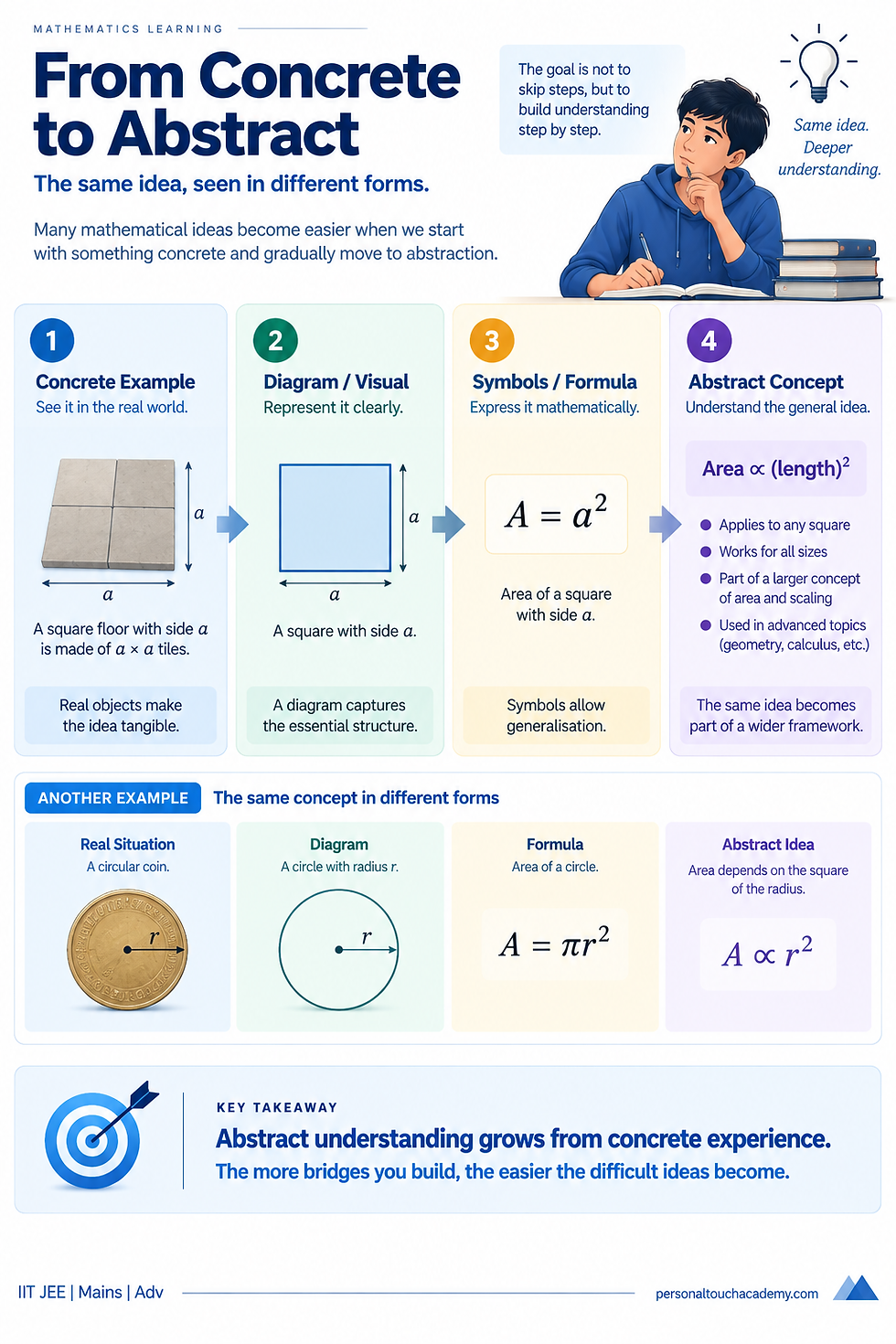
6. From Concrete to Abstract
Many mathematical ideas become easier when we move gradually from the concrete to the abstract. A student may first understand a geometrical picture, then a numerical example, then an algebraic representation, and finally the general principle.
For example, the expression a + b = b + a is easy to memorise. But understanding why addition is commutative is a deeper form of understanding. The student has moved from manipulating symbols to recognising a structural property. Good teaching often works by constructing these intermediate levels. The teacher does not lower the intellectual standard of the final idea; the teacher builds a bridge to it.
7. Why Some Students Need More Steps
Students do not all travel through an idea at the same speed. One student may see a pattern after two examples, while another may need ten. One may understand an equation symbolically; another may need a diagram before the structure becomes visible.
It is easy to interpret the second student as “less intelligent,” but learning speed and ultimate understanding are not identical. A student who needs more intermediate steps may simply require a longer route. The educational task is to discover whether that longer route eventually leads somewhere.
This is particularly important in mathematics, where a student's confidence can collapse after repeated encounters with material that appears immediately obvious to others.
8. Can Cognitive Ability Change?
The idea that cognitive performance is completely fixed deserves a more careful examination. Research conducted for the U.S. Navy's Brain Fitness Training programme explored whether domain-general cognitive abilities, including aspects of fluid intelligence, could be improved through relatively short periods of cognitive training. The programme was designed to investigate the possibility of substantial improvement; it should not be interpreted as proof that every person can increase IQ by a predetermined number of points.
Separate Navy-related research also reported substantial improvement in sailors' reading comprehension following a training programme. These findings do not establish a simple formula such as “40 hours of training equals X points of IQ.” They do, however, fit into a broader educational observation: human performance is not determined by a single number alone.
Knowledge changes. Skills change. Strategies change. Mental models become richer. As those things change, what a person can do can change with them.

9. The Teacher's Job Is to Build the Bridge
Imagine a student standing on one side of a river and a difficult mathematical idea on the other. Telling the student, “Cross the river,” is not teaching. The teacher's job is to determine where the student is standing, where the student needs to go, and what sequence of steps will connect the two.
Sometimes the bridge requires a simpler example. Sometimes it requires revisiting an old concept. Sometimes the student needs to solve ten smaller problems before attempting the larger one. The final concept does not have to be simplified or diluted. What changes is the route by which the student reaches it.
That distinction is central to teaching difficult mathematics. A good teacher is not merely transferring information; the teacher is constructing the sequence of connections through which the student can eventually see the idea for themselves.

10. What This Means for IIT-JEE Students
IIT-JEE preparation inevitably produces moments when a student encounters a problem and thinks, “I will never be able to do this.” That conclusion is usually premature. Before deciding that a problem is beyond your ability, ask a different set of questions: What concept am I missing? Which step in the argument do I not understand? Is the difficulty mathematical, or am I unfamiliar with the language in which the problem is expressed? Can I solve a simpler version of the same problem?
These questions convert an apparently global judgment—“I am not capable”—into a specific learning problem. Once the difficulty has been identified, it becomes possible to work on it. A missing prerequisite can be learned, a weak technique can be practised, and a confusing representation can be replaced with a clearer one.

11. Difficulty Is Not the Same as Inability
There is a useful distinction between saying, “I cannot understand this,” and saying, “I cannot understand this yet.” The second statement is not a guarantee that understanding will eventually arrive. Some ideas genuinely are difficult, and people differ in their cognitive strengths and limitations.
But the distinction prevents us from confusing the present state of knowledge with the permanent boundary of ability. A student who cannot solve a problem today has demonstrated one fact with certainty: they cannot solve it today. Everything beyond that requires further evidence.
12. Individual Differences Are Real
None of this means that intelligence is irrelevant or that every student can reach exactly the same level if given enough effort. People differ in cognitive abilities. They differ in learning speed, memory, reasoning, spatial ability and many other characteristics, and different subjects place different demands on those abilities.
A serious educational philosophy must acknowledge those differences. But acknowledging individual differences is not the same as assigning students permanent intellectual categories. The dangerous step is not recognising that students differ; it is assuming that a present difficulty has already revealed the full extent of a student's potential.
13. How Far Is the Student From the Idea?
Perhaps a better way to think about learning is not simply as a question of whether the student possesses enough intelligence, but as a question of cognitive distance. Imagine that the student's present understanding is at point A, while the target concept is at point B.
A → B
The distance may be small or enormous. Teaching attempts to reduce that distance by adding intermediate points: A → A₁ → A₂ → A₃ → B. Sometimes the student discovers the path quickly. Sometimes the path requires considerable work. The existence of a distance should not automatically be interpreted as evidence of a wall. It may simply tell us that more of the route has to be travelled.

14. IQ 100 Is Not a Wall
An average IQ does not come with a fixed catalogue of ideas that a person is permitted to understand. A person's measured cognitive ability is one piece of the picture. Knowledge, education, experience, conceptual structure and training also shape what that person can understand and accomplish.
The more useful educational question is therefore not, “Is my IQ high enough to understand this?” but, “What do I need to understand before I can understand this?” That question changes the student's relationship with difficulty. Instead of treating a difficult concept as a verdict on intelligence, the student can treat it as a map showing where the missing pieces are.
15. The Academy Lesson
Every serious student eventually meets an idea that appears to be beyond their level. The teacher's responsibility is not to assume that the difficulty has already revealed the student's intellectual limit, but to investigate what lies behind it. What does the student already know? Where does the reasoning break? Which prerequisite is missing? Can the idea be represented differently, or approached through several intermediate steps?
Sometimes that investigation will reveal a genuine limitation. But it may also reveal something much more useful: a gap between the student's present understanding and the understanding they are trying to reach. That gap is where education begins.
A difficult concept is therefore not necessarily a test of whether a student is intelligent enough to learn it. It may simply be a test of how far the student has travelled toward it. For a teacher, that may be the more important question—and for a student, it may be the difference between treating difficulty as a verdict and treating it as the beginning of learning.

Research Sources & Further Reading
The claims about cognitive training in Section 8 are based on documented U.S. Navy and Office of Naval Research programmes. The first source describes the Navy SBIR programme's research goal of substantially improving domain-general cognitive skills, including fluid intelligence, through a modest training investment. The second reports an ONR-supported reading-comprehension programme for sailors.
U.S. Navy Brain Fitness Training — SBIR award: official award record.
Office of Naval Research — Software Program Boosts Sailors' Reading Skills 2 Grade Levels.