Mind Architect: Build the Way You Think
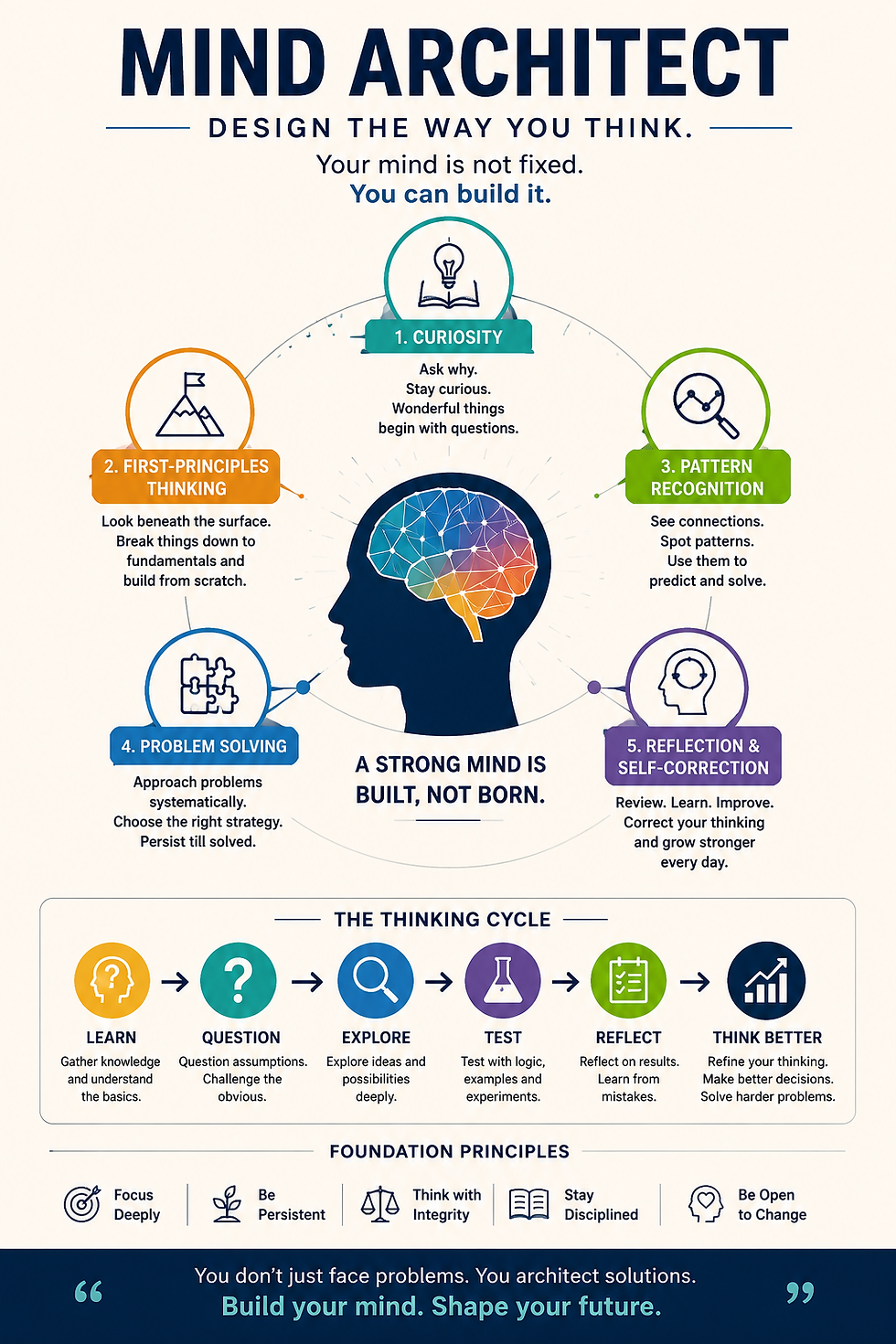
Students often think that becoming better at mathematics means collecting more formulas, solved examples and information. But strong learning is not simply accumulation. It is the gradual construction of a mind that can retrieve, connect, question, test and improve.
Mind Architecture is a practical framework for deliberately developing the way you think, learn and solve problems.
The Core Architecture
Purpose: know what you are trying to understand. Decompose: break a difficult problem into smaller parts. Structure: connect ideas into models and relationships. Explore: try alternatives. Evaluate: test your reasoning. Integrate: turn the lesson into reusable knowledge.
The important point is that this is a cycle. Evaluation can reveal that your structure is wrong; exploration can reveal that the original question was poorly framed; integration can make the next problem easier to decompose.
From Information to Understanding
Information → Representation → Relationships → Patterns → Abstraction → Generalisation → Application.
A student who only remembers information may perform well on familiar questions. A student who understands relationships can adapt when the numbers, wording or situation changes. This distinction matters enormously in IIT-JEE preparation.
Why Productive Struggle Matters
One of the most important parts of learning is the period when the answer is not yet visible. You read the problem, try an approach, fail, retrieve something you learned earlier, notice a pattern and try again. That struggle is often the process through which the internal structure is being built.
A student who is shown every solution immediately may understand the explanation but still be unable to reproduce the reasoning independently. A student who attempts first is forced to build a path of his or her own.
Mind Architecture and AI
AI makes this idea even more relevant. It can provide explanations, examples, summaries, alternative approaches and complete solutions almost instantly. That creates both an opportunity and a danger.
If a student asks AI to do every difficult step, the technology can replace the struggle that produces learning. If the student uses AI as a scaffold, it can increase experimentation dramatically. A healthier sequence is: Attempt → Get stuck → Form a hypothesis → Use AI for a hint or alternative → Challenge the response → Test → Revise → Explain independently.
Mind Architecture for a JEE Student
Before solving, understand the structure of the question. During solving, generate and test approaches rather than hunting for a remembered trick. After solving, ask why the solution works and whether another route exists. After a mistake, identify the reasoning error, not just the correct answer. During revision, retrieve ideas from memory instead of repeatedly rereading them.
The Real Objective of Education
The deeper purpose of education is not to make a student good at answering a teacher's questions. It is to make the student capable of asking better questions independently: What do I know? What don't I know? What can I connect? What happens if I try this? Why did that fail? Is there another route?
Better architecture can make the same intelligence more useful.
The objective should not be to merely fill the mind. It should be to build an architecture that allows the mind to keep building itself.
Further Reading
For the broader research-oriented framework, see Mind Architecture Method: A Universal Framework for Learning, Life & AI. You can also read AI Scientific Thinking Certification: A Personal Research Scorecard.
Do not merely fill the mind. Build the architecture that allows the mind to keep building itself.